I am up bright and early again. London twice in a week! Not ideal but it's the last few days of a must see exhibition. (that's from my perspective of course). With limited effort Phyllis and I are off down the hill for the early train to Paddington again. Three stops on the circle line and I am back at one of my old haunts. I have vivid memories of coming to High St Kensington back in 82/83 to see my friend Big Jules.

It's not changed so much but I am sure beneath the facade a different population now inhabits this area. Only the older people will be anything other than super well off; thanks to the obscene problem we have with property prices.


I like this advertisement.

To get to my destination I cross Holland Park.
It is lovely and warm and I feel over dressed, especially in the feet!

The park is spread across fifty-four acres of what used to be the grounds of Cope Castle, a large Jacobean mansion hidden in the woods. It was built by Sir Walter Cope in the early seventeenth century. It was renamed Holland House when the Earl of Holland’s wife Lady Rich inherited the property.
Holland House was badly damaged during World War II. One wing was saved and is used as a youth hostel. A remaining section of the front terrace is now used as a distinct backdrop for the park's summertime open-air theatre productions and classical concerts. see below.

I leave the park and am immediately in the area that was inhabited by the Holland Park Circle.

The Holland Park Circle was an informal group of nineteenth century artists who congregated to this area following Sir, Later Lord Frederic Leighton. All but one were Royal Academicians. Read about them here
Frederic Leighton (3 December 1830 – 25 January 1896), known as Sir Frederic between 1878 and 1896, was the English painter and sculptor who I am focussing on today. I am particularly interested in one of his last paintings, and the most famous, Flaming June. I was captivated by this work when I visited my friend in Manhattan in 2014. It was on show at the Frick Museum, NYC. Leighton was bearer of the shortest-lived peerage in history; after only one day his hereditary peerage ended with his death.
I imagine this was the least of his worries.
Frederic was born in Scarborough to a family in the import and export business. His father was a doctor. Educated at University College, he subsequently received his artistic training on the European continent. I like to think that this broadened his mind. Leighton was often described, in fact derided for not being properly British in outlook! From 1855 to 1859 he lived in Paris, where he met Delacroix.
Frederic was born in Scarborough to a family in the import and export business. His father was a doctor. Educated at University College, he subsequently received his artistic training on the European continent. I like to think that this broadened his mind. Leighton was often described, in fact derided for not being properly British in outlook! From 1855 to 1859 he lived in Paris, where he met Delacroix.
In 1860, he moved to London, where he associated with the wonderful Pre-Raphaelites. In 1864 he became an associate of the Royal Academy and in 1878 he became it's President (1878–96). Leighton remained a bachelor and rumours of his having an illegitimate child with one of his models in addition to the supposition that Leighton may have been homosexual continue to be debated today. Enquiry is furthermore hindered by the fact that Leighton left no diaries and his letters are telling in their lack of reference to his personal circumstances. No definite primary evidence has yet come to light that effectively dispels the secrecy that Leighton built up around himself, although it is clear that he did court a circle of younger men around his artistic studio. His asthetic late Victorian house in Holland Park, which is Grade II* listed, has been turned into a museum, the Leighton House Museum. It contains many of his drawings and paintings, as well as some of his former art collection.
The house is beautiful, featuring many of Leighton's inspirations, including his
collection of Iznik tiles. Its centrepiece is the magnificent Arab Hall. This takes me back to my time in Andalucia. The strong arts and crafts influence is also pleasing. In fact the house, which has been open to the public since 1929, is utterly sumptous and a total delight.
Much of the artist's art is on display including the build up and preparatory works for Flaming June.
Flaming June: The Making of an Icon (4 November 2016 - 2 April 2017) is a landmark exhibition for Leighton House Museum, returning Leighton’s most famous and celebrated work to the artist's house from the Museo de Arte de Ponce in Puerto Rico.
Depicting a sensual, sun-drenched, sleeping female figure wrapped in orange draperies against a Mediterranean backdrop, the exhibition explores the extraordinary story of this picture, from its creation in Leighton’s studio, its first critical reception at the Royal Academy, through its ‘disappearance’ in the middle of the twentieth century, its acquisition by Luis A. Ferré, Governor of Puerto Rico for the Museo de Arte de Ponce in 1963 and subsequent rise to international fame as one of the most memorable and reproduced images in the whole of British art.
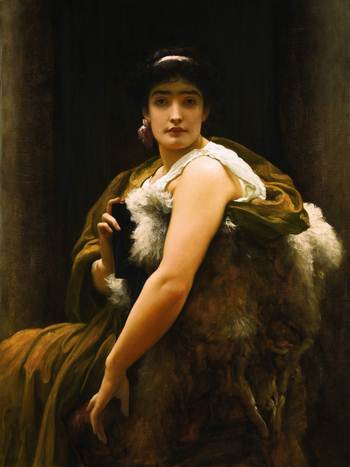 At Leighton House Museum, Flaming June is shown beside the other works submitted by Leighton to the Academy that year, all of which were memorably captured and photographed on easels in Leighton’s studio immediately prior to being sent to the Academy in 1895. They make a fascinating and revealing group, representative of themes and subjects that had informed Leighton’s work over the preceding decades. The Maid with Golden Hair, Twixt Hope and Fear and Candida are on loan from private collections with Lachrymae coming from the Metropolitan Museum of Art, New York. The re-gathering of these pictures places Flaming June back into the context of its original exhibition, providing a compelling starting-point for exploring its history. Leighton was already unwell with the heart condition, angina, that would kill him at the time he made this last Academy submission. It is almost certain that were he alive now, he would have had a much longer and more comfortable innings. The assembled pictures represent his last statement as an artist and allow a reappraisal of his achievements, relating these five works back to the career that led up to their production and understanding the legacy of a creative life that was close to it's end.
Here is the highlight. Flaming June. I do not know, or I cannot explain why I love this painting so much. It is soothing, lifelike and amazing.

I would like to meet Frederic.
I enjoy a very mediocre panini in a nice quiet cafe on the High St then swelter in the train and while cycling up hill. When I get home in my tights and wooly dress I discover it has been 22 degsC. The hottest March day on record! It is my wedding anniversary. Twenty seven years ago the weather was equally lovely but a mere 20 degs.
After a long reviving bath I am out canvassing for the LDs and eating wonderful home made pizza. Finally the groom turns up from the other side of the world!

No comments:
Post a Comment