Sunday, 16 April 2017

Easter at Mottisfont


It's the long Easter weekend, my baby is home and Hermes is well.  So life is good.  
The sun keeps coming out and we are off to Mottisfont Abbey

The estate is a wonderful place to explore, situated in some of Hampshire's most glorious countryside.  There is ancient oak woodland, working hazel and chestnut coppices, wetland meadows and mixed plantations.

The River Test, which flows through the grounds, has shaped the estate through the centuries.  As one of the great chalk streams of the world, it has crystal clear waters. It’s an ideal habitat for wild trout and salmon.


Fertile land and a plentiful water supply attracted the first settlers. The site's name comes from the spring or font shown above.  It is still producing water in the grounds.  It was around this font that the local community held its moots or meetings.  Hence the name, Mottisfont. I want one for our parish council!  

Originally founded as an Augustinian priory in 1201, Mottisfont has been shaped by its many and varied owners. Now it reflects the life and passions of last owner Maud Russell. Inspired by newly-published diary entries, they are currently revealing her experiences of the Second World War period around the house.

Read more about Maud here

Delightful displays of spring bulbs colour the grounds, while trees bud and come into leaf.


We are here to see Maud's art collection and the current Whistler Exhibition
Rex Whistler was one of the many young men whose life was shortened by WW2.  Such a tragedy.  He had his own distinctive style, painting the famous murals described in the link.  I note a discrepancy between Maud's account of his time at Mottisfont and his own!


I also enjoyed a tour of the Maids' quarters.  As ever in these places, I am reminded of my Gran's kitchen. 


Afterwards Jo and I walk by the Test. 


We meet up with T in the walled garden. 


 Tulips flower in the walled gardens.


When we get home Jo cooks a lovely meal and then we discover and remove a tick on the old rabbit! 

Thursday, 6 April 2017

Waking up in West London and enjoying Art with Friends


R & L's West London flat reminds me of our early days in Brixton.  It's nice to wake up there and see the sun over the early Edwardian terraces.  After breakfast we take a slow bus to Oxford St and meet my Art Historian at the royal academy of arts  We enjoy the small three roomed exhibition america-after-the-fall


It is an era I knew little about. I learn more about the meaning of the American Dream.  The government invested in the people and there was a chance for all to succeed.  This is what Europe, especially Southern Europe and Northern Britain needs now.  R is a left winger and backs me on this. 
Clockwise from the top 
New Year Movie 1939 Edward Hopper
Street Life, Harlem 1939 William H Johnson 
Young Corn 1931 Grant Wood (A new favourite for me) 
Home Sweet Home 1931 Charles Sheeler

We picnic in the park with the Art Historian.  Next we have the chance to see her show featuring the artist Cathie Pilkington. Anatomy of a Doll has been installed in the Life Room of the RA. It was inspired by Degas' dancers.  
The Life Room is unchanged since the early 19th century and is reminiscent of the Old Operating Theatre.  Indeed, in those early days there was a close association with anatomists who were the experts on depicting the human form.  Life drawing was a compulsory part of the postgraduate course at the RA until the 1990s.  


Love the quads stretch 


The Christ figure on the crucifix is courtesy of a murderer who was hanged. He has donated his body without consent.  Gruesome.


The sculpture of the dog is extremely life like.  We discover him in the 'pews'


Here are my friends with the lovely Charlie who explains so much to us about the history of the school and the artist herself. 


Now it's time for me to head home.


Tuesday, 4 April 2017

The Three Fires

I leave mid afternoon on the posh train for Paddington.  It's my course at The Buddhist Society again.  After a pleasant stroll across Hyde Park,  I notice the Memorial Gates on Constitution Hill for the first time (I am embarrassed to admit).  I discover that they commemorate the armed forces of the Empire who served for Britain in both World Wars; all in all five million volunteers.  Sobering. 


I arrive at the ICA
to have a cuppa and blueberry muffin and see the exhibition by the Australian artist Helen Johnson. 


Spot the rabbits. They were introduced into Australia from the West.  I enjoy her work. 

I walk to Pimlico


The talk is from the original scriptures on the Three Fires or poisons Read more here
Anger and Craving are easy to understand and work on.  But delusion is the basis of it all and much more tricky.  

We also cover the  Fire Sermon 
This is of great importance to Buddhists.  Their own Sermon on the Mount.  

Then it is the Bakerloo line to Queens Park and meeting my friends in
Wonderful tapas, great service. Decent Redemption beer.  To bed in West London. 

Thursday, 30 March 2017

Leighton House, Holland Park and Kensington


I am up bright and early again.  London twice in a week!  Not ideal but it's the last few days of a must see exhibition.  (that's from my perspective of course).  With limited effort Phyllis and I are off down the hill for the early train to Paddington again.  Three stops on the circle line and I am back at one of my old haunts.  I have vivid memories of coming to High St Kensington back in 82/83 to see my friend Big Jules.  


It's not changed so much but I am sure beneath the facade a different population now inhabits this area.  Only the older people will be anything other than super well off; thanks to the obscene problem we have with property prices. 


I like this advertisement.  


To get to my destination I cross Holland Park.  
It is lovely and warm and I feel over dressed, especially in the feet!  

The park is spread across fifty-four acres of what used to be the grounds of Cope Castle, a large Jacobean mansion hidden in the woods. It was built by Sir Walter Cope in the early seventeenth century. It was renamed Holland House when the Earl of Holland’s wife Lady Rich inherited the property.
Holland House was badly damaged during World War II. One wing was saved and is used as a youth hostel. A remaining section of the front terrace is now used as a distinct backdrop for the park's summertime open-air theatre productions and classical concerts. see below. 


I leave the park and am immediately in the area that was inhabited by the Holland Park Circle.


The Holland Park Circle was an informal group of nineteenth century artists who congregated to this area following Sir, Later Lord Frederic Leighton.  All but one were Royal Academicians.   Read about them here 

Frederic Leighton (3 December 1830 – 25 January 1896), known as Sir Frederic between 1878 and 1896, was the English painter and sculptor who I am focussing on today.  I am particularly interested in one of his last paintings, and the most famous, Flaming June.  I was captivated by this work when I visited my friend in Manhattan in 2014.  It was on show at the Frick Museum, NYC.   Leighton was bearer of the shortest-lived peerage in history; after only one day his hereditary peerage ended with his death.
I imagine this was the least of his worries.  

Frederic was born in Scarborough to a family in the import and export business. His father was a doctor.  Educated at University College, he subsequently received his artistic training on the European continent.  I like to think that this broadened his mind.  Leighton was often described, in fact derided for not being properly British in outlook!  From 1855 to 1859 he lived in Paris, where he met Delacroix.
In 1860, he moved to London, where he associated with the wonderful Pre-Raphaelites.  In 1864 he became an associate of the Royal Academy and in 1878 he became it's President (1878–96).  Leighton remained a bachelor and rumours of his having an illegitimate child with one of his models in addition to the supposition that Leighton may have been homosexual continue to be debated today. Enquiry is furthermore hindered by the fact that Leighton left no diaries and his letters are telling in their lack of reference to his personal circumstances. No definite primary evidence has yet come to light that effectively dispels the secrecy that Leighton built up around himself, although it is clear that he did court a circle of younger men around his artistic studio. His asthetic late Victorian house in Holland Park, which is Grade II* listed, has been turned into a museum, the Leighton House Museum. It contains many of his drawings and paintings, as well as some of his former art collection. The house is beautiful, featuring many of Leighton's inspirations, including his collection of Iznik tiles. Its centrepiece is the magnificent Arab Hall.   This takes me back to my time in Andalucia.  The strong arts and crafts influence is also pleasing.  In fact the house, which has been open to the public since 1929, is utterly sumptous and a total delight. 
Much of the artist's art is on display including the build up and preparatory works for Flaming June. 
 Flaming June: The Making of an Icon (4 November 2016 - 2 April 2017) is a landmark exhibition for Leighton House Museum, returning Leighton’s most famous and celebrated work to the artist's house from the Museo de Arte de Ponce in Puerto Rico.
Depicting a sensual, sun-drenched, sleeping female figure wrapped in orange draperies against a Mediterranean backdrop, the exhibition explores the extraordinary story of this picture, from its creation in Leighton’s studio, its first critical reception at the Royal Academy, through its ‘disappearance’ in the middle of the twentieth century, its acquisition by Luis A. Ferré, Governor of Puerto Rico for the Museo de Arte de Ponce in 1963 and subsequent rise to international fame as one of the most memorable and reproduced images in the whole of British art.
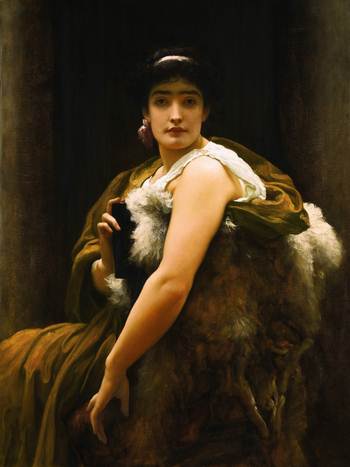
Leighton PaintingAt Leighton House Museum, Flaming June is shown beside the other works submitted by Leighton to the Academy that year, all of which were memorably captured and photographed on easels in Leighton’s studio immediately prior to being sent to the Academy in 1895. They make a fascinating and revealing group, representative of themes and subjects that had informed Leighton’s work over the preceding decades. The Maid with Golden Hair, Twixt Hope and Fear and Candida are on loan from private collections with Lachrymae coming from the Metropolitan Museum of Art, New York. The re-gathering of these pictures places Flaming June back into the context of its original exhibition, providing a compelling starting-point for exploring its history.  Leighton was already unwell with the heart condition, angina, that would kill him at the time he made this last Academy submission. It is almost certain that were he alive now, he would have had a much longer and more comfortable innings.  The assembled pictures represent his last statement as an artist and allow a reappraisal of his achievements, relating these five works back to the career that led up to their production and understanding the legacy of a creative life that was close to it's end.
Here is the highlight.  Flaming June.  I do not know, or I cannot explain why I love this painting so much.  It is soothing, lifelike and amazing.


I would like to meet Frederic.

I enjoy a very mediocre panini in a nice quiet cafe on the High St then swelter in the train and while cycling up hill. When I get home in my tights and wooly dress I discover it has been 22 degsC.  The hottest March day on record!   It is my wedding anniversary.  Twenty  seven years ago the weather was equally lovely but a mere 20 degs.

After a long reviving bath I am out canvassing for the LDs and eating wonderful home made pizza.  Finally the groom turns up from the other side of the world!

Tuesday, 28 March 2017

Springtime in London


It's a lovely spring day and I wake bright and early having readjusted to the clock change.  All ready for a day out in London!  But first.....blueberries and porridge.  

I enjoy my cycle to the station on Phyllis followed by the nice big eight coach 9.24 (slightly delayed).  I seek solicitude in the quiet compartment. 

After a fruitless search for Time Out, the circle line takes me to St James and soon I am re-united with my lovely old friends (old as in long standing that is) in the cafe.


After a walk in the Royal Parks, we picnic with my lovely daughter in Green Park.  The photo of her has been labelled horrendous and so will not be appearing.

I really love the exhibition, Revolution, Russian Art 1917-1932.  There is more info here .  I learn a lot about the revolution, which sadly, I feel extrapolates quite well to the current USA, and buy a short book so as to learn more.  I am also re-united with the optimistic Marc Chagall of the 1920s as he swings his bride in the air, a painting I also saw in the Museo Ruso .  I see paintings, films and photographs in a style I have not really encountered before.  They depict the offical Stalinist version of socialist art as well as examples from when things became temporarily more flamboyant and liberal 


Top Left Clockwise: Deineka Ping Pong, Lebedev Portrait of the Dancer and Choreographer, Advertisement Rodchenko and Mayakovsky, Unknown Advertisement. Many Thanks to JT.

We have tea in the best table of The Keep, overlooking the now heavily securitised coutyard and enjoy delicious cakes.  

We say our sad farewells and I walk to Belgravia for a talk.  I ponder the sad events of tomorrow as I pass the Belgian Embassay


then the Italian 


My talk at the Buddhist Society is really good tonight.   Is is about the 
I am left realising that one of these has been affecting my judgement most of the day. No further details!  

The train is too busy (more hindrances), I eat a squashed peanut butter sandwhich and go home to beer and Broadchurch!  

Sunday, 26 March 2017

Oxford in Springtime

The clocks sprung forward last night but I cope.  I am out bright and early at the new 9am in glorious sunshine.  It's chilly though. 

You cannot beat the almond croissants at cafe loco where I have breakfast and meet my friend.  

Next we are back in harris manchester chapel .  I cannot argue with the sentiments in the Burne Jones windows. 


The services of the unitarians never fail to uplift me.  Today the highlights are the address on Liberalism and a reading from the Buddhist Scriptures on the futilty of worrying about life after death.  

We emerge to find the EU flag still flying high. 


My feedback is below


I also wonder about the time I was four years old and had injections for pneumonia in Pendlebury Hospital.  What a horrible time.  I still remember being made to eat cornflakes, the fish tank and missing Mummy who could not visit much. I think the injections were streptomycin not penicillin.  I think the former should have been mentioned in the ex, but it is pretty good.  Interestingly, I don't have a horrible memory of the injections.  

Back out into the spring day. 


We have a wander around Christchurch Meadows and then it is back to the Park and Ride.


What a lovely day. 


Tuesday, 21 March 2017

Another trip to London

I get the train late morning after doing some admin on a sunny and cold day.  I have lunch with my baby in Green Park then walk all the way to Tate Britain via St James Park. 
I love the city but wish ordinary people could live at it's heart. 

I arrive tired but am soon envigorated by the  Hockney Exhibition at tate-britain I enjoy early work from the 60s which I have not seen before.


More classic work from the 60s and 70s


The Artist's parents


Then I am into the 80s


Lastly I enjoy works produced in Yorkshire which we saw a few years ago as well as the iPad series. 


Best of all were his amazing sketches including a self portrait done when David was 17 in 1954, the year I was born.

Revived by a massive piece of carrot cake and a pot of earl grey I wander through Pimlico to the Buddhist Society for a talk on the early scriptures. 

I have a peaceful train ride home amused by a little black pug.